Overview
AISUS delivered internal visual, cleaning, and ultrasonic thickness (UT) inspection of a seawater lift caisson on an offshore platform in the Dutch Sector.
The project highlighted AISUS’ ability to mobilise at short notice to global locations. The inspection equipment was requested on a Thursday, mobilised by the following Tuesday, and the AISUS team was on site in Holland the following Monday.
The inspection revealed severe internal wall damage and evidence of caisson movement, enabling the client to take early preventative action.

Requirement
This inspection formed part of an overall picture for the client, with AISUS having previously cleaned and inspected the adjacent caisson. By comparing findings against historical data between the two caissons on AISUS’ data management platform, the client can understand integrity over time.
The client required a comprehensive internal inspection, delivering high-resolution visual data and accurate wall thickness measurements across all zones of the caisson, including above water, the splash zone, and subsea.

Challenges
Known defects in an adjacent caisson increased concern over the integrity of the seawater lift caisson.
The pump failure was later linked to damaged cables, likely caused by internal fretting within the caisson.
A cable tray bolt had caused deep fretting damage to the internal wall.
High sea states during inspection caused caisson movement within the guide frame, resulting in vibration that impacted visual image quality.
Solution
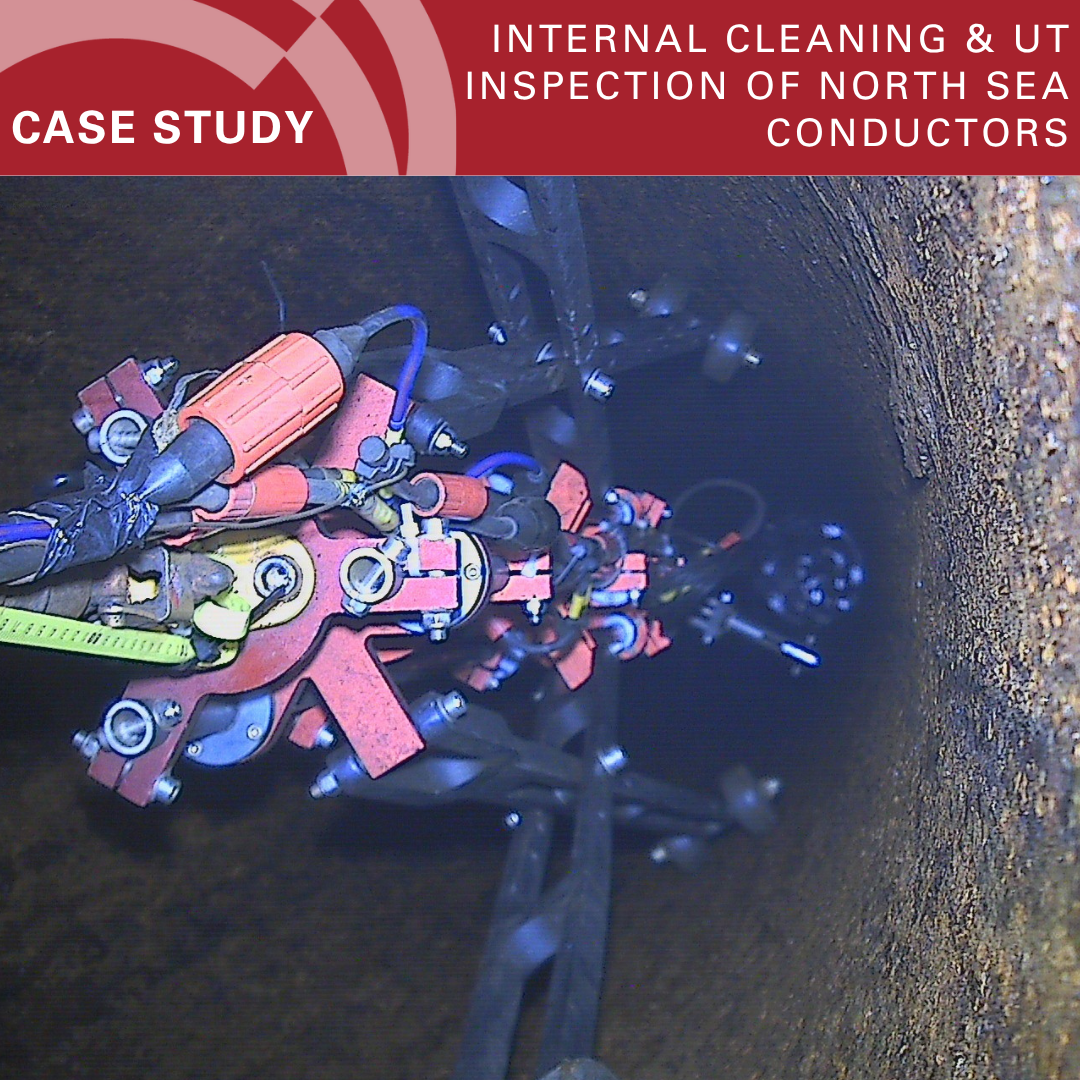
AISUS delivered a full internal caisson inspection using remote visual inspection, high‑pressure water cleaning, and ultrasonic testing.
The scope included:
- Pre‑cleaning visual inspection to identify debris, foreign objects, and blockages.
- Controlled high‑pressure water cleaning to remove marine growth while minimising risk to coatings and parent material.
- UT wall thickness mapping at 10 × 10 mm intervals, both circumferentially and axially.
- Post‑cleaning visual inspection focusing on welds and internal anomalies.
The AISUS Sirius tool, equipped with UT capability, was deployed to capture data across all inspection zones. A severely damaged area was identified during the initial visual inspection, and the client elected not to subject this area to high‑pressure cleaning to avoid further degradation. In selected areas, minor marine growth was retained to ensure reliable UT readings.

Results
- Previously unknown internal damage and caisson movement were identified.
- Significant wall loss, cracking, and multiple holes were recorded, primarily caused by fretting with the guide frame and internal components.
- Wall loss around the pump assembly and circumferential welds was clearly documented.
- Detailed reporting was delivered, including images, dimensional data, UT C‑scan outputs, and annotated video footage.
All inspection data was uploaded to the AISUS data management platform, providing secure access to current and historical inspection results.
Benefits
- Early detection of critical defects, reducing the risk of unplanned failure.
- Clear comparison with previous inspection data, supporting informed integrity assessments.
- Rapid mobilisation minimised operational downtime.