Overview
For more than a decade, AISUS has deployed remote robotic inspection technologies across offshore assets worldwide, providing operators with safe and cost-effective access to critical infrastructure. Through thousands of inspections, AISUS has built an extensive dataset on the condition and degradation of offshore caissons, many of which continue to operate beyond their original design life.
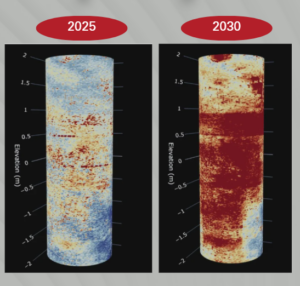
Project c|Ai|sson was developed to transform this inspection data into a predictive integrity management tool. By combining historical inspection records, environmental conditions and corrosion modelling, the system forecasts future wall thickness and identifies areas at greatest risk of degradation, allowing operators to move from reactive inspection programmes to proactive asset management.

Requirement
Operators require accurate information to understand the current condition of ageing offshore assets and to prioritise maintenance and intervention activities. While traditional inspection campaigns provide a snapshot of asset condition at a specific point in time, they offer limited visibility of how degradation may progress between inspection intervals.
AISUS set out to develop a solution capable of forecasting future corrosion behaviour, supporting long-term integrity planning and enabling risk-based decision-making across individual assets and wider asset portfolios.
Challenges
Corrosion within offshore caissons can be difficult to assess and predict due to the number of factors influencing degradation rates. Variations in operating conditions, environmental exposure, seawater chemistry and historical asset performance all contribute to different corrosion profiles across seemingly similar assets.
The challenge was to develop a system capable of analysing large volumes of inspection data while retaining engineering credibility and delivering outputs that could be easily understood and acted upon by integrity teams. Predictions also needed to be explainable, traceable and linked to physical factors recognised by engineers rather than operating as a “black box” AI solution.
Solution
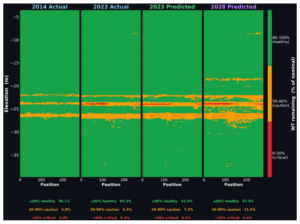
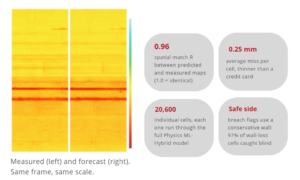
To validate the platform’s predictive capability, AISUS conducted a blind test using historical inspection data from a North Sea operator. Known inspection results were withheld from the model, requiring it to independently forecast future wall thickness and degradation behaviour before being benchmarked against actual inspection findings.
The platform achieved a 0.96 spatial correlation between predicted and measured wall thickness maps, accurately forecasting degradation patterns across the asset. Across more than 20,600 measurement locations, the average variation between predicted and actual wall thickness was just 0.25mm.
Using a conservative breach-detection approach, the model successfully identified 97% of wall-loss locations, demonstrating its ability to forecast future integrity risks and support proactive decision making. The results showed how historical inspection data can be transformed from a record of past asset condition into a tool for predicting future degradation and prioritising integrity activities.
Benefits to Client
Project c|Ai|sson transforms historical inspection records into actionable intelligence, allowing operators to make decisions based on predicted future asset condition rather than solely on past inspection results.
The platform enables assets and inspection zones to be ranked according to operator-defined risk thresholds, providing a flexible framework for integrity management. For example, operators can define their own risk criteria, such as wall thickness above 80% as Healthy, between 50-80% as Caution, and below 50% as Critical.
By identifying areas of elevated risk before they become operational concerns, integrity teams can prioritise inspections, target maintenance activities more effectively and support life-extension strategies with greater confidence. This provides a more proactive and risk-based approach to managing ageing offshore infrastructure while helping operators focus resources where they are needed most.