Overview
AISUS mobilised to an offshore platform in Australia to carry out internal inspections on two J-tubes, with the objective of assessing the extent of external wall loss. The collected data was used to evaluate the condition of the platform legs by correlating it with the observed J-tube external wall corrosion.
The platform legs are divided into watertight tanks containing MEG, seawater, and a magnetite slurry. The analysis aimed to determine whether any of these contained fluids have contributed to increased levels of corrosion compared to the others.
Requirements
The inspection aimed to obtain accurate Visual and Ultrasonic data across two J-tubes.
Prior to inspection A hydraulic cutting tool was deployed via crawler to the messenger wire ferrule, where a cut was performed at 10.00m. This enabled deployment of the tool.
SCORPIUS: Navigates the bend enabling UT to be carried out in the horizontal section of the J-Tube.
SIRIUS: to take measurements above sea level, through the splash zone and subsea.
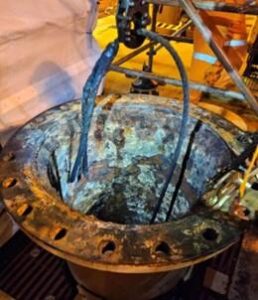
HP jetting operations were also performed from the top of the J-Tubes down to 84.00m to remove hardened scale and corrosion, preparing surfaces for UT inspection and detailed RVI.
Challenges
- Limited operational time window due to environmental constraints and adverse weather conditions
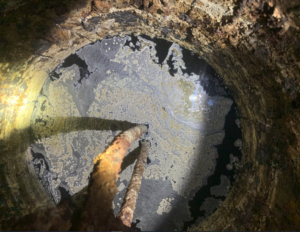
- Poor visibility within the subsea section both pre- and post-jetting due to suspended debris and biocide presence
- Irregular geometry of the J-tubes affected UT data acquisition accuracy
- Risk of overflow during jetting operations due to capped J-tubes
Solution
A submersible pump was deployed during jetting operations to prevent overflow within the capped J-tubes.
Inspection strategy was adapted to account for non-symmetrical geometry, ensuring usable UT data was still obtained.
Results
Despite challenging environmental conditions and limited visibility, AISUS successfully completed the internal inspection of both J-tubes on time. The collected data provided valuable insight into external wall loss and supported the assessment of corrosion behaviour across different platform legs.
Benefits
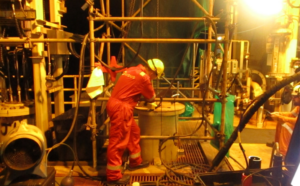
Integrated Service: All tasks completed within a single service.
Accurate Data Collection: The combination of HP cleaning, visual inspection and UT provided a thorough and reliable dataset supporting the assessment of corrosion behaviour across platform legs.
Operation completed within Timeframe: Despite challenging environmental conditions and limited visibility, AISUS successfully completed the inspection without extending project timeline, avoiding delays and additional costs for the client.